Inquiry
Form loading...
Acoustic Vents help maintain airflow while limiting the passage of unwanted sound. Choosing the right model takes more than comparing product descriptions. A vent that performs well in a quiet test room may behave differently beside a busy road, a humming fan, or a thin partition. Small details matter: duct depth, opening size, mounting position, and the path sound can travel around the unit. The goal is a workable balance, not silence at any cost.
Acoustics researcher Professor Trevor Cox has written extensively about how people experience sound in buildings. The following is a paraphrase of a broader acoustic-design principle, not a verbatim quotation: “A sound solution must suit the room and the way people use it.” That distinction matters. For this guide, we will look at airflow requirements, acoustic ratings, pressure drop, materials, and installation constraints. A high sound-attenuation figure alone can mislead if the vent restricts ventilation or does not fit the wall assembly. Check the test conditions, too. Ratings are useful, but they cannot predict every room.
There is no perfect choice. Start with the noise source, the required airflow, and the available space. Then compare suitable products and confirm their data with the manufacturer or a qualified acoustic professional. A little caution helps. So does measuring the actual opening before ordering.
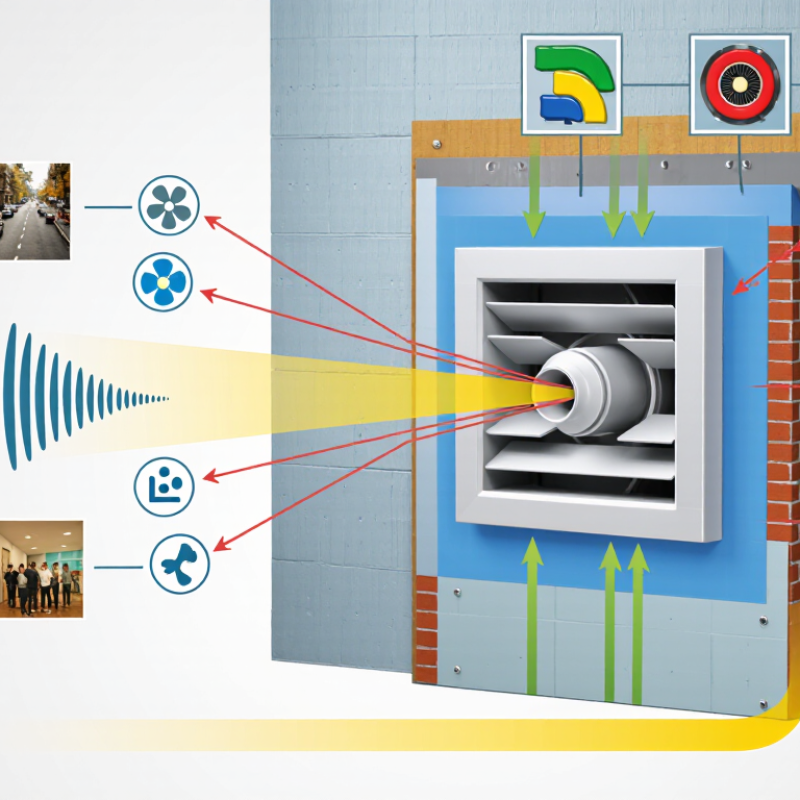
Acoustic vents reduce noise by making sound travel through a longer, less direct path. Internal baffles interrupt sound waves, while porous linings absorb some energy, especially at middle and high frequencies. Low traffic rumble is harder to control. A vent that seems quiet in a showroom may perform differently beside a busy road.
The World Health Organization’s 2018 Environmental Noise Guidelines for the European Region recommend keeping average outdoor night noise below 40 dB Lnight to reduce health risks. This is a health guideline, not a guaranteed target for any vent. For product comparisons, check independent laboratory results, such as the weighted element-normalized level difference, Dn,e,w, measured under ISO 10140-2. Higher values generally indicate better sound insulation, but installation gaps and wall construction can reduce real-world performance.
Airflow matters too. A tightly baffled vent may block more sound but restrict fresh air. Check acoustic test results alongside airflow data, and confirm both suit the room and wall thickness. A small detail matters: seal the frame fully, or sound can leak around the vent. Not always obvious. During a renovation, note traffic noise with windows open and closed; that simple observation can help set realistic expectations.
| Vent or design approach | How it reduces noise | Airflow and pressure considerations | Often suited to | What to check before choosing |
|---|---|---|---|---|
| Acoustic louvre | Angled, sound-absorbing blades interrupt the direct sound path while allowing air to pass. | Blade spacing and depth affect both free area and airflow resistance; confirm the pressure drop at the required airflow. | External walls, plant rooms, and openings where weather protection and ventilation are also needed. | Tested sound reduction by frequency, free area, pressure-drop data, weather performance, and installation depth. |
| Baffled or splitter attenuator | Air passes between sound-absorbing splitters, reducing the direct path for sound travelling through a duct or opening. | More or thicker splitters can increase attenuation but may also increase resistance and reduce the available airflow area. | Ventilation ducts and larger openings where the available space can accommodate the required length and depth. | Attenuation across relevant octave bands, airflow capacity, pressure drop, and whether the dimensions fit the duct. |
| Acoustically lined vent or duct section | Porous lining absorbs some sound energy as sound travels along the passage; longer lined paths generally provide more opportunity for absorption. | The lining reduces the internal cross-section slightly. Surface protection may be needed where airflow could carry dust or moisture. | Ducted ventilation routes where there is enough space for a lined section or a longer sound path. | Lining material, cleanability, fire requirements, clear internal area, pressure drop, and frequency-specific test results. |
| Acoustic transfer grille | An internal baffle arrangement allows air to move between spaces while reducing a direct line of sight for sound. | Performance depends on grille size, baffle layout, and the required airflow; a free-area check helps avoid excessive air velocity. | Room-to-room air transfer where a conventional open grille would allow too much sound through. | Sound reduction, airflow at the intended operating condition, mounting depth, and compatibility with the wall construction. |
| Vent with a resonant or tuned element | A resonator is designed to reduce sound around a selected frequency range rather than acting as a broad-band absorber. | The tuning depends on the element’s dimensions and surrounding conditions; airflow and acoustic performance must be evaluated together. | Applications with a known, dominant tonal noise, such as a clearly identified equipment or fan tone. | The target frequency, tested performance near that frequency, operating airflow, and sensitivity to installation conditions. |
| Open or unattenuated vent | Provides an airflow path but offers little intentional sound attenuation compared with a suitably designed acoustic vent. | Usually has a relatively unobstructed path, but actual airflow still depends on the opening, grille, and system pressure. | Locations where ventilation is the priority and sound transfer through the opening is not a significant concern. | Whether the opening creates an unwanted direct sound path or compromises the room’s acoustic separation. |
Selection note: Acoustic performance varies with the vent’s dimensions, construction, airflow, and installation. Compare test data by frequency band and review pressure drop at the required airflow; a single overall noise-reduction figure does not describe performance at every frequency.